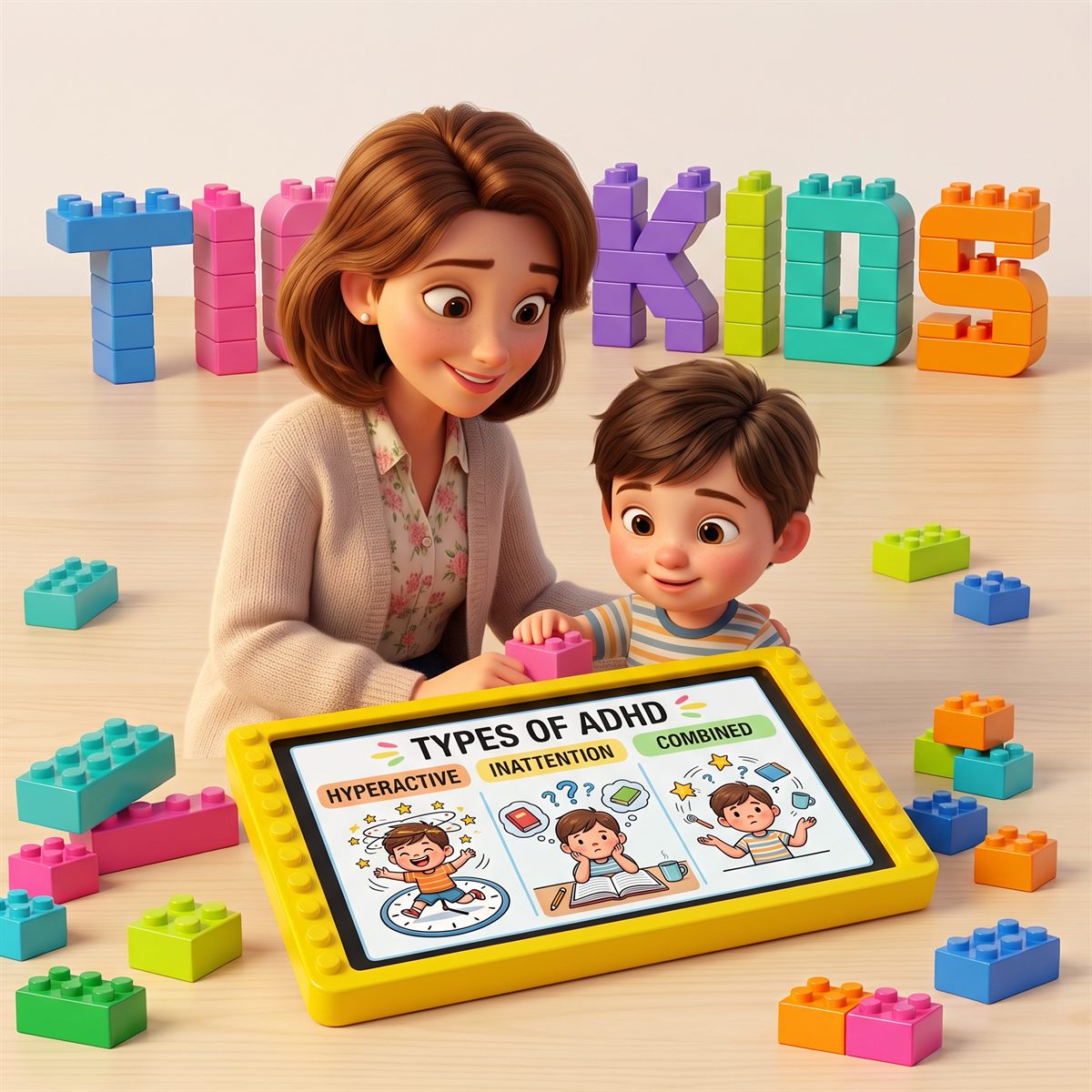
The Types of ADHD in Kids: Inattentive vs Hyperactive
August 17, 2026
When people picture ADHD, they picture a kid bouncing off the walls. But that's only one face of it — and the one that gets diagnosed is often not the one that struggles most quietly. ADHD comes in three presentations, and knowing the difference changes how you understand your child.
This article is educational and not a substitute for professional evaluation. Only a qualified clinician can diagnose ADHD. If something here sounds like your child, it's a reason to talk to a professional — not to self-diagnose.
ADHD isn't one thing
The CDC and the diagnostic manual clinicians use (the DSM-5) describe three presentations of ADHD:
- •Predominantly inattentive
- •Predominantly hyperactive-impulsive
- •Combined (both together — the most common in children)
The label matters because the inattentive type looks nothing like the stereotype, and so it's the one most often missed — especially in quiet kids and in girls.
The inattentive type (the one that gets missed)
This is the "daydreamer." Not disruptive, not bouncing — just… somewhere else. Common signs of the inattentive type include:
- •Seems not to listen even when spoken to directly
- •Loses things constantly (jackets, homework, water bottles)
- •Struggles to finish tasks, drifting off halfway
- •Easily distracted, forgetful in daily routines
- •Avoids tasks that need sustained mental effort
- •Makes careless mistakes, misses details
Because these kids aren't a problem in the classroom, they often fly under the radar for years. A child with predominantly inattentive ADHD isn't lazy or "not trying" — the brain genuinely struggles to start and sustain attention on things that aren't immediately rewarding.
The hyperactive-impulsive type
This is the presentation people recognize. Signs include:
- •Fidgets, squirms, can't stay seated
- •Runs or climbs when it's not appropriate
- •Talks excessively, blurts out answers
- •Struggles to wait or take turns
- •Always "on the go," as if driven by a motor
The combined type
Most children with ADHD have the combined presentation — inattentive and hyperactive-impulsive signs together. A child can also shift over time; the hyperactivity often softens with age while the attention challenges remain.
"Is it ADHD, or just being a kid?"
Every child is sometimes distracted, restless, or forgetful — that's childhood, not a disorder. What separates ADHD is that the signs are persistent (months, not a bad week), show up in more than one place (home and school), and genuinely get in the way of daily life. That judgment isn't one a checklist or an online quiz can make — it takes a professional evaluation.
What actually helps, day to day
Whatever the type, the same everyday supports help — and they help any child, ADHD or not:
- •Make the routine external and visual. An ADHD brain struggles to hold "what's next" in its head. A routine your child can see takes that load off their memory — and off your voice.
- •One step at a time. A long list overwhelms; a single next step is doable. Break big tasks into small ones.
- •Immediate, clear feedback. Delayed rewards don't land the same way. A small "done!" moment on each step keeps the momentum.
- •Predictable structure. Same order, same place, every day. Predictability is calming and builds the habit.
This is exactly what a visual routine does — and why it's the first thing recommended for inattentive kids who "just can't get started." We go deeper in how a visual schedule helps a child with ADHD, and you can build a free printable one with our Morning Routine Builder.
When to talk to a professional
If the signs are persistent, show up in more than one setting, and are affecting school, friendships, or home life, it's worth talking to your pediatrician or a child psychologist. Early support changes outcomes — and a diagnosis is a door to help, not a label to fear. Organizations like CHADD and the CDC have reliable, parent-friendly information to start with.
How Tick Kids fits
Tick Kids won't diagnose or treat ADHD — no app can. What it does is make the daily routine visible, simple and rewarding, which is exactly the kind of structure that helps an inattentive or hyperactive child follow their day with less nagging. You build the tasks around your family, your child checks them off and earns stars, and the routine starts to run itself.
See how Tick Kids works — or try it free, one child, five tasks, no card.